


 ReputatioLab, Saper Vedere's laboratory for crises and reputation · File updated on 13 September 2026 · reputatiolab.com →



Publication rhythm
Key takeaways
What nine years of parliamentary data analysis teach us
- Lobbying leaves a mechanical trace: the duplicate. On the agriculture bill, 35.5% of the 4,537 amendments are duplicates from farming lobbies, explanatory statement copied included.
- What is declared is negligible. Across the whole corpus analysed, only 143 amendments are attributed to an identified lobby, or 0.2% of the total. The rest can only be read by cross-matching data.
- Everything concentrates on money. The 2026 Finance Bill carries 64 coordinated series on its own, 45% of the total; four files account for 78% of them.
- The country's second-largest lobby is local authorities. Départements et Régions de France come second with 15 duplicates, the AMF fourth with 6: elected officials pushing for their institutions.
- Volume does not convert. LFI tables 27,000 amendments in a year and gets only 3.9% adopted, while LIOT, with 21 MPs, gets as many adopted.
- Reaching the stage of the law means arriving too late. The influence sector let two years of signals go by, and its federation was not registered with the HATVP.
The amendment, the trace that does not lie
This file rests on one unit of account: the amendment, the only parliamentary act that leaves a signed trace comparable over time. The Follaw amendment guide counts 69,286 of them across 165 legislative files, and sets out the statistic that puts everything in its place: only 16% are adopted, and the government itself has only a 47% chance of getting its own through.
The duplicate, the signature that never fades
The analysis of the 2024 agriculture bill set the method. Of 4,537 amendments, 35.5% are duplicates originating from farming lobbies: an interest group writes a turnkey amendment, hands it to MPs from several groups, and all of them table it. The other tactics can be read too: a third of the social housing section of the 2025 Finance Bill consists of probing amendments, and two peak months add up to 37,354 obstruction amendments.
That MPs should take up a highly technical amendment mechanism is understandable. That MPs, in explaining why they propose the mechanism, copy lobbies' explanatory statements word for word is incomprehensible.
ReputatioLab, Lobbying and the making of the law, 2024Transparency is very uneven: of the 100 amendments processed among the 240 similar ones, LR signs nearly 47.3%, and it is the group that says least about where they come from. The duplicate is not an agricultural curiosity: across the whole parliamentary term, 38% of amendments on agriculture have a duplicate.
To compare with what Parliament declares about itself: 143 amendments explicitly attributed to a lobby, or 0.2% of the total. Voluntary declaration measures nothing; cross-matching duplicates does.
Tabling is not converting
The relative majority has blown up volumes without changing the yield. The review of the first year of the 16th parliamentary term counts 89,324 amendments tabled against 37,593 in 2017, about 2.4 times more. Fewer than half are discussed: 34,554. Nearly 20,000 are inadmissible, including 11,063 under Article 40. And 6,185 are adopted, fewer than in 2017, when there were 6,404.
LFI tables nearly a third of the year's amendments and gets only 3.9% adopted; LIOT, with 21 MPs, gets as many adopted. Obstruction is not pointless for all that: it serves a media objective, which the analysis names. But it should not be confused with legislative influence.
The Assembly can no longer be seen as a mere rubber-stamp chamber.
ReputatioLab, Review of amendments, 2023Who really carries weight on a text
Two blocs stand out, and the second is surprising. Agriculture first: the FNSEA comes top with 34 duplicate amendments, while the second-placed player has 15. With the Chambers of Agriculture (7), the Jeunes Agriculteurs (2) and the FNEDT (2), these four players account for 45 of the top 15's 95 duplicates, nearly half.
The second bloc is not private. Départements et Régions de France come second with 15 duplicates, the AMF fourth with 6, mostly on the private member's bill on the status of the local elected official, one of the most heavily amended texts in the corpus with 293 duplicates.
In fact, some of the best-relayed interests are not private interests at all. They are elected officials pushing for their own institutions.
ReputatioLab, The influence of lobbies on the making of the law, 2026The groups that act as relays
The breakdown of sponsors leaves no doubt: it is the government and right-wing axis.
Pressure concentrates where the money is. The 2026 Finance Bill carries 64 coordinated series, 45% of the total, ahead of the emergency agriculture law (23), Social Security financing (15) and end of life (10): these four files account for 78% of coordinated activity. The written question barely registers, with 49 duplicates out of 17,117 questions.
Intensity varies enormously from one text to another
Nothing is uniform: end-of-life legislation drew 5,439 amendments in 2024, then 1,410 on palliative care and 3,801 on assisted dying in 2025, with the parliamentary right accounting for nearly 70% of tabled amendments. MERCOSUR, conversely, received only 36 amendments between 2022 and 2025, or 0.02% of the total, yet every motion for a resolution debated since 2023 has been adopted. In between, the loss of shops in town centres prompts 65 amendments, 34 questions and 32 players, and cancer 43 questions, 26 of them in October. Other texts never take off: green industry remains sporadic, the regime for JONUM goes through an ordinance, and the 2025 Finance Bill prompted only 710 tweets in September in the panel.
One federation, three points of entry
The FNSEA case shows a web of contacts rather than a single relationship: 8 to 10 main MPs, a regional relay, three channels.
 The departmental federations
They target local MPs and bring together the Rassemblement national's members, who are self-contained elsewhere.
They seek votes on the left and obtained acceptance of Green and LIOT amendments.
They capture the centrists and the executive, and two years later rank third among sourced lobbies, with 7 duplicates.
The same logic had been measured elsewhere. During the drought of summer 2022, the analysis of debate arenas shows three strategies: Les Républicains occupy the parliamentary ground (22% of activity), NUPES the media ground (44% of mentions on Twitter), and the Rassemblement national pre-empts questions on the farming side (56%) while being absent from social media. Around 40% of MPs were reached by farming demands, mostly Renaissance members: they see, but do not speak.
What ministers follow, and what they do not
The other way to measure access is to look at the executive's network. By reconstructing the accounts followed by ministers before the 2025 Finance Bill, the study finds 9,770 different accounts on X against 1,454 unique people on Instagram, overwhelmingly other politicians. Three families dominate: farming networks, the local economy, a societal ecosystem. Health, automotive, aviation and energy are absent: precisely the sectors identified as losers of the text.
X
 Instagram
LinkedIn
Instagram
LinkedIn
The same exercise on the Lecornu government yields an ecosystem dominated by politics and the media, with few economic, civil society or citizen relays. The summary fits in four words: very institutional, very offline.
Arrive before the law, or do not arrive
The most constant regularity in the file is not a figure but a calendar: the life cycle of an issue, in five stages. Lobbying that fails is almost always lobbying that wakes up at the third.
- Emergence. An issue appears and attracts public and media attention.
- Interest groups. Stakeholders take positions, weigh on opinion and form alliances.
- Legislation. Decision-makers draft the text. This is where many lobbies wake up, and try in three weeks to respond to an issue that is several years old.
- Judicial enforcement. Courts interpret and sanction; a period of adaptation is negotiated.
- Administrative implementation. Administrations apply and enforce.
Activation. The stage that everyone knows, and that 80% of clients want without the other two.
ReputatioLab, Which matrices for public affairs, 2024The agriculture bill offered a real-life test: a winner and a loser on the same text.
Amendments carried by groups that are not their natural allies, and accepted: little volume, real conversion.
39 announced amendments, tabled only within the NUPES and Green spheres, in scattered order: an autopilot strategy, plenty of numbers and no result.
Two years of ignored signals, no alliance, a federation never registered with the HATVP, and an open letter that ended in retracted signatures.
This case is the best documented: the signals were dated. A warning from Bercy in April 2021, a front-page press story on “influvoleurs” in July 2022, a ministerial announcement in November 2022, a round table at Bercy in December 2022. The legislative step was written; the sector had prepared nothing.
The executive is no exception to the rule. On the so-called “rabbit tax”, it revived an old issue, 27 million missed appointments every year, backed by two parliamentary questions, and which it had itself set aside in the Senate. No consultation, the central booking player in opposition, and immediate objections over digital exclusion.
The blind spot
A law can be born without any radar having seen it coming. On the private member's bill on hair discrimination, the analysis finds no coalition, no mobilised association, no parliamentary question, and only 103 tweets over a year in the panel. The text passed through a parliamentary niche day, with 4 amendments in committee and 13 in the chamber. The subject did exist on Instagram, however, where posts reached 28k likes, out of reach of monitoring tools. It was the bill that created the media surge, not the other way round.
Measuring noise without mistaking it for influence
Several analyses challenge the idea that volume equals influence. On farming mobilisations, the spontaneous hashtag exceeds 3 million tweets while the FNSEA's peaks at 18,000. The explanation is not the message but the tooling: parties have had rapid-response units for years, federations have not.
The study of the top 400 hashtags, across 1,250 accounts of federations and trade unions, confirms a dated usage: 58% generic themes that nobody follows any more, 15% campaign, 15% event, 11% news. And a blunt finding: over a year, no coalition was deployed at the same moment on a specific issue. They exist in press releases, not on social media.
When a mobilisation really takes hold, the question becomes one of outcome. The petition against the Duplomb law is the only real test: put online on 11 July 2025, it reached 1.5 million signatures eleven days later, including more than 460,000 on the 21st. Until then, only one petition had passed 100,000 signatures since 2020. Yet the mechanism only opens a debate in the chamber above 500,000 signatures, and nothing more.
583 opinion leaders in a week, 8 million impressions, 156,000 shares. A neighbouring petition goes from 3.5 to 398 signatures a day along the way.
 The controversy that does not break through
The spheres that condemn and those that buy do not overlap. Parliamentary questions are at a standstill, and reacting amounts to promoting.
 When noise becomes manipulation
Two anti-Uber accounts change identity while keeping their followers, claim to be a lawyer and then a doctor, and insinuate themselves among journalists.
Consumers are of no use in public affairs. Their relationship with the company is utilitarian, not political. They do not buy in, they buy.
ReputatioLab, Shein and the consumer as a weapon, 2025There remains the opposite temptation: believing that data predicts what is coming. In the 17,000-person panel, the Agricultural Show generated 9,519 mentions over the year, against 2,533 for the mobilisation that followed. The themes that carried it had not been positioned beforehand, and the first call to turn the road signs upside down received next to no pickup. A bias compounds this: the ratio between those who produce content and those who are passive is estimated at 30-70.
Data is not, and never will be, predictive when it comes to social matters.
ReputatioLab, Data is not a crystal ball, 2024What this changes for an organisation
Monitoring institutional corpora. The cross-analysis of SBF 120 companies is clear: parliamentary questions are the most useful corpus, since ministers are obliged to answer them and the media draw on them. The study is candid about the limit, as the direct reputational interest remains low: the contribution is sector-specific, and helps to set a tempo.
Start from the issue, not the bill. This is the founding principle of the tool: a subject becomes a societal issue before it becomes a bill. Searching by keywords does not work, since the everyday name of a bill is never its legal title: hence 750 pre-built queries across 23 major themes.
Position yourself before acting. The five steps say what to do; the matrices described in the file say with whom and how: Meet, Want, Must to sort stakeholders; Drivers, Issue, Trends to open entry points; Lowi-Wilson to read the distribution of costs and benefits, and to know whether to act discreetly or mobilise widely.
File usefully, and co-sign. An amendment carried by the government or the rapporteurs passes; the opposition alone very rarely. Co-signing, for its part, shows in the results: 59% of the amendments taken up by the government during the 49-3 votes on the 2023 finance bill were co-signed, and 70% of those outside the government. Convergences exist on technical or territorial subjects, with pairs of co-signatories identifiable bill by bill.
Respond quickly, clearly, everywhere. The analysis of product recalls yields four reflexes: act fast, be clear about the product and the steps taken, give people a reason to act, and multiply channels. It also reminds us, for an anxious executive, that there were no more than 173 stakeholders talking about the subject, and no amendment or question beyond the vehicle recalls: the phenomenon was a media one, not a political one.
Equip yourself without delegating judgement. The two analyses devoted to AI come from practitioners who use it. The proven uses are real: summarising on verified data, capturing the National Assembly and Senate in around five minutes, and catching the amendment slipped into a file you were not following. The limits are just as real: around 30% hallucination on average, up to 60% depending on the model, and a tool that does not know the client. Two precedents: a fintech that replaced around 700 agents before reversing course, and a monitoring company announcing 217 job cuts out of 383 before stopping.
Method
These analyses draw on data from Follaw, Saper Vedere's legislative monitoring platform: amendments, questions, records of proceedings and agendas, cross-matched with a hand-built social media panel. The 2026 analysis adds the HATVP and processing by AI agents; its authors themselves point out that attributing an amendment to a lobby remains open to debate. Several studies are co-signed by Mélody Mock-Gruet, two conducted with Le Trombinoscope.
The analyses behind this file
Each lesson in this file points to one of these articles, published by ReputatioLab. They are sorted by sub-theme, from most recent to oldest.
Lobbying in the making of the law

What is the influence of lobbies on the making of the law?
According to some, there is advocacy and there is lobbying. In the end, there is above all pressure on parliamentarians to make the voice heard of a sector, an interest or a part of the public that MPs and senators are readily inclined to favour.
Read on ReputatioLab →
Agriculture bill: which lobbies win out, and what is the winning strategy?
It is time to take stock of how lobbies influence legislation, and the recent examination of the agriculture bill is a striking example.
Read on ReputatioLab →
Lobbying and the making of the law: how to identify it? The case of the agriculture bill
The National Assembly has begun examining a new agriculture bill, intended to address farmers' frustrations and secure the future of the next generations in the sector.
Read on ReputatioLab →
The Follaw amendment guide
We are running a “Procedure and Advocacy” Competition built around the amendment. It is therefore the perfect opportunity to take stock of amendments using Follaw and all our methodologies.
Read on ReputatioLab →
Decoding the amendments taken up during the 49-3 votes on the 2023 Finance Bill (first reading)
We analysed the 185 amendments taken up during the 49-3 votes on the 2023 Finance Bill. (here or here) It is telling: the second most represented group is Les Républicains (14%), followed by the Democratic and Republican Left (6%).
Read on ReputatioLab →
Review of amendments: first year of the 16th parliamentary term (data analysis)
Context: 28 June 2022 was the first sitting marking the opening of the 16th parliamentary term. Since the emergence of majority rule in 1962, this is only the second time that the Government has not had an absolute majority in the National Assembly.
Read on ReputatioLab →
When influencers are unable to influence the National Assembly
What greater irony than to see influencers come unstuck so badly in the very den of influence, over the bill that concerns them. And yet that is what we are seeing, with a far too late reaction, clumsy execution and, in the end, legislation that is going to fall.
Read on ReputatioLab →
Uber vs Taxi: the taxi lobby deploys very dubious weapons on Twitter
If you are a regular reader of the blog, you know this is a saga I follow with delight, as there is a genuine battle of influence under way. In the previous episodes, I produced a full review of lobbying on social media, and I decoded Uber's #LaissezNousTravailler campaign.
Read on ReputatioLab →Bills and governments followed under the microscope

Decommercialisation of town centres: parliamentarians pass
Is town-centre retail going through a slow death, like the one French industry suffered through deindustrialisation? The question is indeed pressing as the term “decommercialisation” features more and more in debates.
Read on ReputatioLab →
How much influence does the Lecornu government have, and how can it be influenced digitally?
The Lecornu II government comes at a time of mistrust and a recomposition of influence relationships. We wanted to play with our new toy, the Social Impact Score, to analyse the various ministers. It makes it possible to objectify this influence by assessing ministers' ability to weigh on European, political, economic and media dynamics.
Read on ReputatioLab →
Lecornu's appointment: the themes that command consensus between the PS and LR
Health was at the centre of Prime Minister Sébastien Lecornu's first official trip, on Saturday 13 September 2025 in Mâcon (Saône-et-Loire). A harmless choice? We were able to identify health as one of the few areas of convergence between the Parti socialiste (PS) and Les Républicains (LR).
Read on ReputatioLab →
Social housing: has the 17th parliamentary term kept its promises?
As part of our partnership with Le Trombinoscope, we carried out this study to highlight the place of social housing in the political and media debates of the 17th parliamentary term.
Read on ReputatioLab →
Duplomb law: the first real test of the citizens' petition mechanism launched by the National Assembly in 2020.
What if Article 10 became the last resort of a Parliament jostled by 1.5 million signatures? As a reminder, on 11 July 2025, the petition was put online on the National Assembly platform. On 22 July: 1.5 million cumulative signatures.
Read on ReputatioLab →
End of life: 2024-2025 comparison and analysis of parliamentary and societal issues
End of life: after the dissolution, parliamentary business resumes in a different climate. Nine months after the surprise dissolution of the National Assembly decided by Emmanuel Macron, one of the major social reforms of the five-year term has resumed.
Read on ReputatioLab →
Cancer: sustained and steady parliamentary work
As part of our partnership with Le Trombinoscope, we carried out this study to highlight the place of cancer in public and political debate.
Read on ReputatioLab →
MERCOSUR: is the French Parliament the spearhead of opponents within the European institutions?
The free trade agreement signed between the European Union and Mercosur on 6 December 2024 marks a major turning point in trade relations between Europe and Latin America (Brazil, Argentina, Uruguay, Paraguay and Bolivia).
Read on ReputatioLab →
Product recalls: legislation is doing its job
On Tuesday, Le Parisien published an article, “Multiplication des scandales alimentaires : que peut-on encore manger sans craindre la contamination ?”, on mass product recalls and growing consumer concern over frequent food scandals, despite tighter food safety controls.
Read on ReputatioLab →
Which lobbies are best placed to influence the new government on social media? The case of the 2025 PLF
The drafting of the 2025 Finance Bill (PLF) is already generating intense media activity. And with good reason: many sectors and companies are at risk of being affected. Which of them have a card to play on social media?
Read on ReputatioLab →
2025 Finance Bill: communication is running as late as the text
Every year, the finance bill plays a decisive role in France's budgetary and fiscal direction. For 2025 it carries particular weight, as it will affect the life of the Barnier government.
Read on ReputatioLab →
No-show tax: has the government been stood up?
The government pulled a “no-show tax” out of its hat, which managed to get the whole health sector worked up. This measure, backed by the Prime Minister, plans to impose a €5 penalty on patients who miss their medical appointment without warning or who cancel less than 24 hours in advance.
Read on ReputatioLab →
Hair discrimination bill: is hairstyle political?
A private member's bill to combat hair discrimination has been adopted by the French National Assembly. Put forward by MP Olivier Serva, the bill proposes adding discrimination based on the “cut, colour, length or texture of hair”
Read on ReputatioLab →
Green industry: a sector-specific text that does not thrill the crowds
To strengthen France's attractiveness and competitiveness and to meet the Government's ambition of placing climate issues at the heart of its action, a new course of reindustrialisation must be taken.
Read on ReputatioLab →
JONUM: towards a boom in NFTs thanks to legislation?
All hands on deck for gambling operators over the “Jonum project” (monetisable digital object games), with one main grievance: a distortion of competition between a heavily taxed gambling sector and players such as Sorare.
Read on ReputatioLab →
The method and tools of public affairs

AI and public affairs: uses, risks, regulation and the survival of the profession
If there is one profession that has not adapted to technological challenges, it is public affairs. Yet an enormous technological disruption is about to hit, and it is probably the one too many. Which uses are already established today?
Read on ReputatioLab →
Shein: is the consumer the best lobbying weapon?
BHV had probably not anticipated that its collaboration with Shein would set off such an earthquake. Since announcing the arrival of the Chinese ultra fast fashion giant in its store, the retailer has entered a zone of economic and reputational turbulence.
Read on ReputatioLab →
What artificial intelligence means for communications and public affairs professionals
Artificial intelligence: the buzzword to drop into every conversation whatever the subject.
Read on ReputatioLab →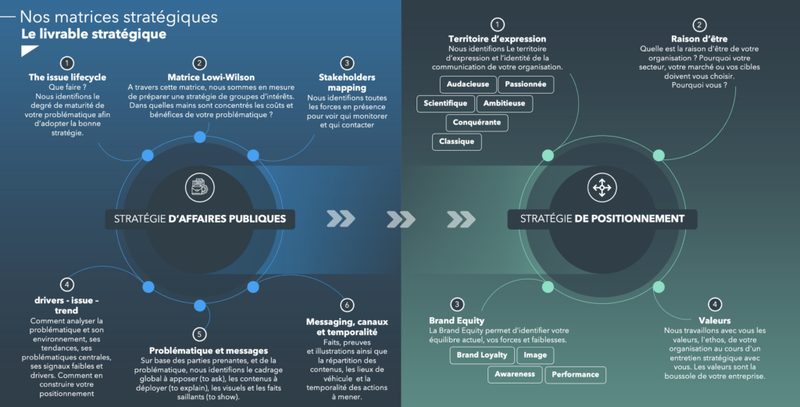
Public affairs and societal issues: which matrices to grasp them?
The teaching of public affairs is so outdated (“Just read Hobbes's Leviathan”) that people in communications or marketing often see consultants as dinosaurs before their time, working the mouse through two applications: Word and Outlook.
Read on ReputatioLab →
How can public affairs monitoring be of interest to communications directors?
If there is one thing that has always surprised me, it is the weak cooperation between communications and public affairs teams within large groups.
Read on ReputatioLab →
Analysis of the farmers' protest: data in public affairs is not a crystal ball
We are emerging from a strong mobilisation of farmers who voiced their exasperation with a whole series of demands. Was this uprising foreseeable? How was it expressed? Were signals not heeded? I thought it would be interesting to return, with data, to what preceded this mobilisation.
Read on ReputatioLab →
Lobbying and hashtags: how to structure hashtags for the purposes pursued?
While the hashtag #Agriculteursencolère explodes with no fewer than 3 million tweets, the FNSEA's hashtag #OnmarcheSurlatête peaks painfully at 18,000 tweets. How can this be explained? And beyond this very specific case, how do lobbies use hashtags today?
Read on ReputatioLab →
Genesis of Follaw.sv - a legislative and institutional monitoring platform dedicated to public affairs
While I have written a great many analyses on this blog, I have only rarely recounted my life or career stages here. If you missed the previous episodes: after my research career at UCL, I joined full time the agency I had co-founded: Saper Vedere.
Read on ReputatioLab →