Our latest study
Study of the economic sphere →
The agency · Philosophy

Understand society.
Earn the social licence.

Our philosophy is a framework: the social licence to operate and to communicate, the link between communications and public affairs, the historical evolution of stakeholders, an understanding of the contemporary Agora, and the life cycle and typology of societal issues. A shared reading framework that structures every mission - from societal intelligence to public affairs, from influence communications to crisis management.

The agency that makes an impact.

Alongside the traditional missions - marketing, product, innovation - that add value for our clients, we activate complementary instruments, rarely combined elsewhere. Two purposes, combined levers: creating value, and preserving value. Both over ten years.

01

Creating value

Three instruments combined, which work together as leverage:

  • Societal intelligence - understanding the sector, the communities, the signals of opinion. Adapting before being taken by surprise.
  • Public affairs - securing funding, the consent of political institutions, and the right to operate in the territories.
  • Influence communications - widening the impact of executives' public statements. Bringing out a narrative that carries.
Three levers, one team. A cumulative effect that few agencies know how to orchestrate.
02

Preserving value

Securing an organisation over ten years means defending two rights that are contested today:

  • The right to operate - increasingly challenged by legislation, project challenges and local resistance (NIMBY, NGOs, elected officials, public opinion).
  • The right to communicate - some sectors are actively prevented from speaking. The window closes before they even make their case.
Social licence to operate, social licence to communicate: both are won and lost. Simultaneously.

The window for action is closing faster than before.

The days when an organisation could separate its operational issues from its communications issues are over. A factory contested locally becomes a national issue within 48 hours, carried by a coalition of associations and elected officials. A badly timed statement on TikTok hits the legitimacy of a brand built over thirty years.

To understand society is to accept that these two licences are won together: what we do and how we talk about it are judged together, by players who were not at the table yesterday.

To hold on to these two licences over time, two levers - long thought of in silos - must talk to each other.

Communications is not the froth of public affairs.

COMMUNICATIONS SERVING PUBLIC AFFAIRS

Getting ahead, not following the debate.

Communications serves as an early-warning tool: it lets us detect what is rising before it becomes a parliamentary matter. It builds a competitive advantage by occupying a narrative ground before competitors do. It brings together the KOLs, experts and opinion relays who then carry the advocacy. And it provides pressure tools: petitions, mobilisations, testimonials - levers that an influence note alone does not have.

PUBLIC AFFAIRS SERVING COMMUNICATIONS

Connecting online to offline.

Public affairs connect what is said online with the local networks where decisions are built: local elected officials, professional federations, parliamentarians. They offer a reading of the French politicised economy - where the State remains a central player and regulation a double-edged sword. They turn a narrative into public action: a law, a decree, a favourable regulatory framework.

Treating these two levers in silos means losing both. Our conviction: think communications with the codes of public affairs, and vice versa.

But you still need to know who you are talking to. In sixty years, the lens for reading an organisation has changed three times.

The evolution of the organisation's operating system.

Three figures have piled up over sixty years. Reading an organisation today means knowing where the three games are played in parallel.

 
1960s
 
Shareholder
Shareholding
1980s → 2010
Emergence, then professionalisation, of communications
Stakeholder
Broader interest
Since 2013
Emergence of a new notion
Interestholder
Person with no stake
Definition

An entity holding shares in an organisation. Partial ownership and direct decision-making rights.

An entity with an interest in the organisation, which affects or is affected by it. Broadening the priority beyond shareholders alone is more likely to lead to success and long-term growth.

Individuals or social groups with no stake in the organisation but who, for a limited time or for a very specific cause, will be mobilised on its behalf, or will turn against it because it represents a prime target.

Players
  • Shareholders
  • Owners
Internal
  • Shareholders, owners
  • Company employees
  • Bondholders
  • Partners
External
  • Customers
  • Suppliers and vendors
  • Local communities
  • Governments
  • Unions
  • Campaigners
  • Activists
  • Social groups
  • Experts who can be mobilised
  • All stakeholders useful for a temporary interest
Example

When Apple becomes the first American company to reach a valuation of $1 trillion, its shareholders benefit directly.

TotalEnergies

If Total decides to open a new headquarters, the company must pay attention to potential new employees who will take part directly in day-to-day operations, and on whom the organisation's productivity and growth depend. But Total must also pay attention to local businesses and residents concerned about the impact on their communities.

The butcher & the vegans

A butcher is attacked by a community of vegans because he sells rabbit. The vegans are not stakeholders and lose interest when the butcher stops selling rabbit.

These three figures - shareholders, stakeholders, interestholders - now coexist in a public space that has itself been reshaped.

The public space has changed in make-up.

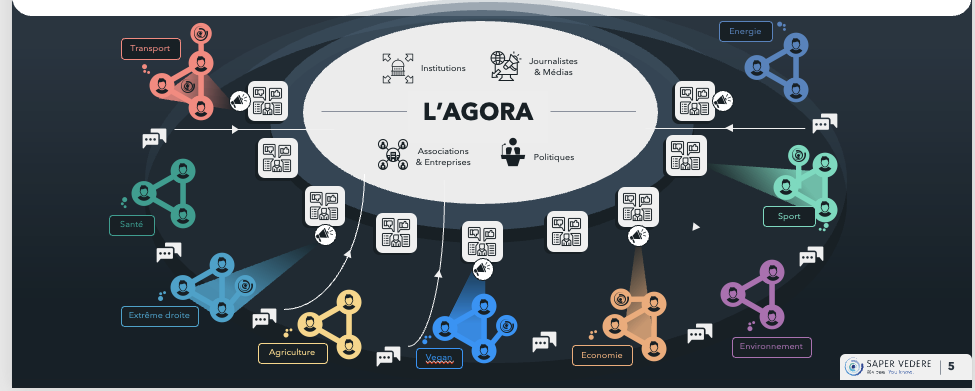
The contemporary Agora is no longer made up solely of the historic institutions, parties and media. Social communities that weigh on the debate have joined them.

The contemporary Agora: institutions, media, politicians, associations and social communities (vegans, agriculture, environment, transport, health, energy, sport, economy, far right).
Around the institutions, media, politicians and associations now orbit nine social communities: transport, health, far right, agriculture, vegans, economy, environment, sport, energy.

For an organisation, ignoring these communities is no longer an option. Understanding them and engaging with them is part of the strategic work - not to blend in, but to avoid becoming their target through neglect.

In this reshaped space, every societal issue follows a trajectory. Knowing where it stands means knowing what to do.

Five stages. The “what”.

Once the issues around a client have been identified, we place them in their life cycle. Each stage calls for a different action: raising the subject, defusing it, building alliances, slowing the law down. An illustration with a recent case: the electric scooter.

01Emergence

Appearance of the issue

A new issue attracts the attention of stakeholders: the public, media, experts. New technology, social or economic change - a need for regulation or political action takes shape.

Scooter Electric scooters appear in big cities. A new urban mobility option, but with safety problems and problems managing public space.
02Interest groups

Positioning and alliances

NGOs, associations, companies and unions take a position. Campaigns, studies, events: everyone tries to influence opinion and decision-makers. Alliances are formed.

Scooter The services contact cities about mobility alliances, approach business leaders, and negotiate with street furniture providers for parking spaces.
03Legislation

Bills and debates

Parliamentarians and governments draft bills and regulations. Debates, public consultations. This is often when the lobbies wake up: “oh, there's a law?” - and try, in three weeks, to respond to an issue that has been there for years.

Scooter Seeing the scooter-city alliance, the unions try to stop the Navigo pass being replaced by scooters. The street furniture provider pushes for a ban on free-floating.
04Judicial enforcement

Interpretation and litigation

The courts interpret, settle disputes and impose sanctions. Appeal periods and adaptation periods are negotiated - as mobile operators did for roaming.

Scooter Disputes multiply: liability for accidents, parking, exclusion zones. Transitional arrangements are negotiated before strict enforcement.
05Administrative implementation

Enforcement on the ground

Municipalities and government agencies take over: monitoring systems, sanctions, information campaigns. The issue enters everyday administration.

Scooter Mandatory parking zones, speed limits by district, fines. The file moves from the legal departments to the highways departments.

But not all societal issues are played out with the same balance of power. Four configurations, four strategies.

Four types of societal issue, four response strategies.

01

Mass-market issues

Diffuse costs, diffuse benefits. A soft societal consensus, broad but poorly organised mobilisation. Strategy: own the educational ground.

02

Political issues

Diffuse costs, concentrated benefits. A small group has a lot to gain. Strategy: decode the influence game and challenge the capture.

03

Sector issues

Concentrated costs, concentrated benefits. Direct confrontation between coalitions of interests. Strategy: a sector coalition and proof of the public interest.

04

Entrepreneurial issues

Concentrated costs, diffuse benefits. A few players bear the cost for a collective benefit. Strategy: document the contribution and defend the model.

One common scenario remains: the organisation lacks the legitimacy to speak directly about the subject that concerns it. It then needs another entry point.

When legitimacy is lacking, find the shared interest.

An organisation does not always have the legitimacy to speak directly about a subject. An industrial company talking about the ecological transition is viewed with suspicion. A humanitarian NGO talking about drug prices has no natural interlocutor at Bercy. In these situations, trying to speak head-on is doomed to fail.

The approach we advocate: identify a shared interest with the targeted decision-maker - common ground where the organisation and the public interlocutor have an objective reason to converge. That ground creates the entry point.

EXAMPLE · INDUSTRY

Energy-intensive industrial company & ministerial cabinet

Blocking issue: an industrial group wanted to push a low-carbon aviation file. The ministry was reluctant to receive an industrial player from the sector on an ecological transition subject. Shared interest identified: decarbonising the sector. A defensible public position for the ministry, a real operational stake for the industrial company. The file goes through.

EXAMPLE · NGO

Humanitarian NGO & pharmaceutical industry

Blocking issue: engaging in dialogue without compromising oneself. Shared interest identified: access to healthcare. Ground where both players have evidence to contribute, complementary networks and cross-legitimacy. The dialogue exists, without either diluting itself in the other.

We map this shared interest in the scoping phase of every public affairs or influence communications mission. It is what separates a generic influence note from advocacy that lands.

Let's meet!

Let's discuss your strategic challenge. No-commitment first conversation.