


Find out your ranking in the ecosystem
Saper Vedere continues its series of analyses on the dynamics of influence within the major societal ecosystems. After the political and media spheres, this study focused on the economic and financial ecosystem. The aim: to understand the logics of influence, map the active communities and analyse the position of SBF 120 business leaders and companies using the Social Impact Score.
1. Analysis of the economic and financial ecosystem
A structured ecosystem in transition
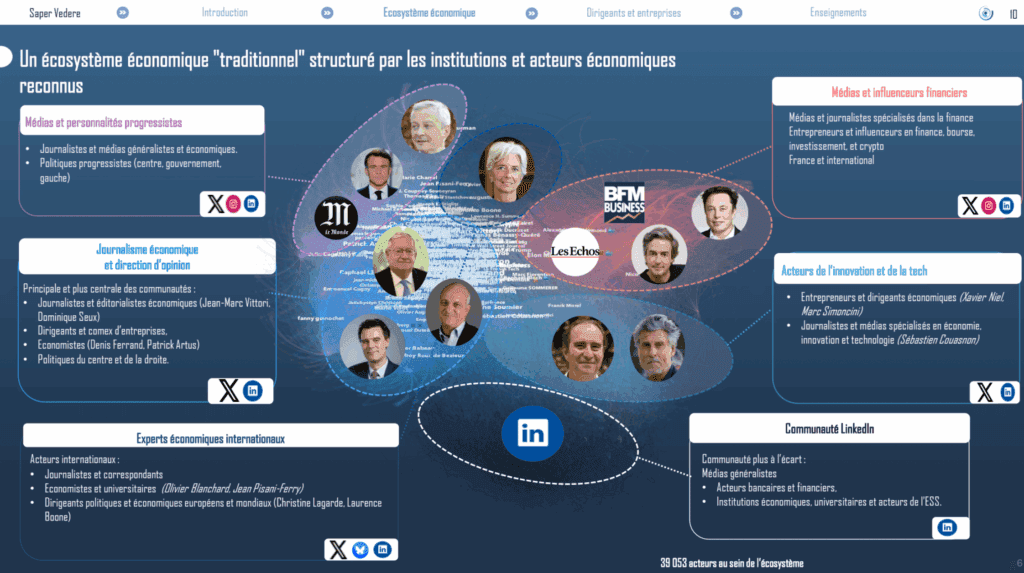
The analysis of a panel of 400 economic and financial decision-makers, journalists and analysts reveals a highly institutionalised universe, dominated by:
- Economic journalists and editorial writers (Jean-Marc Vittori, Dominique Seux).
- Recognised economists (Denis Ferrand, Patrick Artus).
- Political leaders and officials (Bruno Le Maire, Emmanuel Macron).
This ecosystem rests mainly on X (formerly Twitter) and LinkedIn, the two essential platforms for reaching decision-makers and influencers.
New communities: the emergence of “influencers”
Alongside traditional players, a new generation of financial influencers is shaking up the codes:
- Strong presence on TikTok, Instagram, YouTube, in addition to X and LinkedIn.
- Communities of several hundred thousand people.
- A more educational and conversational tone, encouraging engagement and co-creation.
While their audience is mostly the general public, their growing role obliges organisations to monitor them and to consider targeted partnerships.
2. How influential are SBF 120 business leaders in the economic bubble?
The most influential business leaders
The podium of SBF 120 CEOs in the economic sphere mirrors the overall Social Impact Score ranking:
What makes up their influence
- A personal and committed message that goes beyond company issues (e.g. purchasing power, urban planning, innovation).
- A 360° media presence (traditional media + social media).
- A clear and regular editorial strategy, adapted to the platforms’ codes.
Companies: influence that is still limited
The major financial institutions (Société Générale, Amundi, Crédit Agricole, BNP Paribas) dominate the corporate ranking, but remain on the whole little followed by economic decision-makers.
Findings:
- Communications that are too corporate (HR, CSR, internal life), with little appeal for economic circles.
- Little real influence on LinkedIn (only 6 of 120 companies genuinely followed).
- Promising experiments: Crédit Agricole on TikTok and BeReal, Amundi with the Finfluencer Awards.
3. Strategic lessons and recommendations
1. A closed ecosystem, but one that is opening up
- Institutional networks and the business press keep a central place.
- Financial influencers are widening the conversation to the general public and reinventing the codes (videos, stories, lives).
- Companies must monitor these new voices to avoid leaving others in control of their economic reputation.
2. The platforms to prioritise
- X (formerly Twitter): unavoidable for the business press and market decision-makers.
- LinkedIn: a key platform for building credibility and reaching economic circles.
- TikTok and Instagram: useful through partnerships with influencers, but hard to invest in directly.
- Bluesky: relevant only for international players.
3. Corporate communications: an effectiveness deficit
- Too much content focused on the employer brand or internal communications.
- Little appeal for decision-makers, who look for analysis, strategic signals and positions taken.
- The editorial line needs rebuilding to link financial communications, foresight and societal topics.
4. New territories of influence to watch
- The crypto and blockchain community is the only one to have organised itself autonomously.
- It concentrates strong momentum and attracts new audiences: a laboratory of usage worth following.
5. A premium on personal embodiment and risk-taking
- Business leaders who step outside the strictly corporate frame gain influence.
- Three keys: personal embodiment, commitment on societal issues, formats adapted to the platforms.
- Examples: Alexandre Bompard, very active on purchasing power and the food transition; Véronique Bédague, who carries an urban and societal vision; Christel Heydemann, who ties her message to innovation and tech.
6. An opportunity to modernise
- Companies can get ahead by adopting the new formats (short videos, visual carousels, lives).
- Monitoring conversations must be complemented by active participation in order to weigh on the debates.
- Partnerships with financial influencers offer a strategic lever for reaching wider audiences.
Conclusion
The French economic sphere remains dominated by traditional logics, but the arrival of financial influencers, new formats and emerging platforms is reshuffling the deck. Companies and business leaders who can combine personal embodiment, editorial risk-taking, adaptation to digital habits and an active monitoring strategy will hold a major competitive advantage in reputation and influence.