Understanding your strengths and assets - historical, economic, legislative, political, societal, communications - in order to develop them and have them ready when the organisation needs them. The Societal Audit sets the objective. And when the objective is clear, everything becomes clear: the levers to activate, the trade-offs to hold, the strategy that goes the distance.
Every organisation is a stack of assets that either protect or undermine one another. We scan them all - no orphan category, no methodological blind spot.
Where the organisation comes from. Crises, commitments, values, capital structure.
Size, jobs, territorial footprint, innovation. The organisation's weight within its sector.
Legal framework, regulatory dynamics, amendments, legislative coalitions.
Positioning games of parties, territorial levels, strategic positioning.
Issues, issue life cycles, internal and societal impact, prioritisation.
Audiences, embodiment, channels, stakeholder network, Social Impact Score.
The Societal Audit comes at the start of every Saper Vedere engagement. It is not sold as a standalone deliverable: it is a phase of understanding that precedes recommendations, activation and follow-up.
We work on a cycle of services - not on fixed products. The audit necessarily leads to other stages (audience study, ecosystem mapping, strategy, parliamentary or communications activation) because understanding produces the action that produces the evaluation that loops back into understanding.
This stance changes everything: an audit is not judged by its length or the number of slides, but by the quality of the decisions it makes possible afterwards.
The audit serves in specific contexts. Triggering it outside those moments produces an expensive deliverable that nobody will read.
To establish a shared understanding before building a public affairs or influence communications strategy. This is the most frequent case.
To size up the prospect's issue, avoid the generic answer and offer a reading of its environment that is already argued.
Communications director, public affairs director, CEO: a societal audit quickly brings the person on board with SV's reading of the issues.
Before a workshop with the internal team or the external ecosystem, the audit produces the raw material that avoids ungrounded brainstorming.
The 6 assets are the object of analysis. The 5 pillars are the methodological rhythm that turns material into decisions: what we do, in what order, and to produce which deliverable.
We scan the 6 major categories of societal assets to identify very clearly the relevant elements that will feed the strategy. Automated scripts, Follaw.sv consolidation, Connexia extraction, sector benchmarks - exhaustiveness is tooled up.
Objective assessment of how effective the assets are: which are real strengths, which are weaknesses, which opportunities and threats emerge in the short and long term. A pragmatic method combined with sector experience gives a reading that stands up in committee.
The point is not to deal with everything but to prioritise. Assets are ranked by long-term viability, business impact and societal reach. Output: a single strategic priority for the year - a common direction for all stakeholders.
Once a direction is set, we roll out tracking indicators and a simple roadmap - shareable with all teams and service providers. Benefit: operational deployment speeds up and what is accomplished becomes measurable, not merely declared.
The organisation's thermometer: a reliable measurement tool, shared with all staff, that lets you see how effective actions are, adjust levers and steer choices throughout the year. Annual update of the audit to check how assets evolve.
Understand where an organisation comes from, and how its history continues to influence its present. This dimension opens the audit because it puts everything else in perspective: a young sector is not analysed like a century-old one, and an organisation born of a scandal is not defended like a polished brand.
We work on three angles. The history of the organisation and of the sector: age, milestones, affiliations to federations, ministries, priority territories. The history of crises and controversies: what marked its reputation, the residual impacts on activity, the commitments made on emerging from a crisis. Values and messaging: what the organisation says about itself, CSR strategy (environment, social, governance), concrete actions and how they are read by society.
The method combines a pre-filled Excel file (internal databases, aggregated news, AI), client documents and the consultant's additional research. The long-term ambition: to automatically connect INSEE sources, institutional websites and Follaw.sv feeds to produce the framework in a few hours.
For a CAC 40 industrial group heavily exposed to debates on decarbonisation, its history of CSR commitments made it possible to frame the gap between the executive's public statements and the real industrial trajectory. This historical reading avoids replaying an already saturated narrative: if the organisation published a commitment five years ago, the right topic for the executive is not to announce it again, but to tell the story of its delivery.
We qualify the organisation's weight within its sector: size, dependent jobs, share of GDP, capital, financial results, any State support. And we put it in perspective: is it a central player on which political expectations weigh (sovereignty, jobs, innovation) or a niche player operating off the radar of public decision-making?
This dimension feeds two strands. First, the economic levers that the organisation can activate in its strategic narrative (tax contribution, innovation, local subcontracting, subsidiaries). Second, the economic impacts that its decisions have on the ecosystem (jobs, competition, territorial footprint).
Sources: pre-filled Excel file fed by AI and news, client documents, sector research. The analysis remains readable for a decision-maker: no infographic with sixty metrics, but figures chosen for their value in making trade-offs.
For a French food manufacturer exposed to structural activism, the economic dimension made it possible to qualify the defensible arguments (local weight in jobs, subcontracting, local tax contribution) versus those that expose it to a counter-attack (margins, relocations, transfer pricing). It is this grid that then structures the corporate message house, rather than a communicator's hunch.
Regulation is rarely a stable state: it is a dynamic. A sector that is lightly constrained today may be about to tip under the effect of a health, environmental or geopolitical alert. This dimension maps the current level of constraint, the legislative pace around the organisation's issues and the coalitions that move the law.
We rely on Follaw.sv: analysis of parliamentary questions, analysis of amendments, detection of co-amendments, tracking of interest representatives. The analysis scripts automatically categorise themes and produce co-amendment maps that reveal the invisible alliances between political groups.
This is probably the dimension where SV's technology most changes the speed of analysis. Where a conventional audit reads reports, we start from quantified parliamentary signals.
Concretely, Follaw.sv consolidates government bills and private members' bills, amendments, QAG/QOSD/QE questions, committee agendas, the JORF, the HATVP register of interest representatives, appointments and elected officials' social media posts. For a professional federation supported on a sensitive legislative file, this consolidation made it possible to move from makeshift Excel monitoring to a logic of anticipation: the amendment that matters is detected within hours of being tabled, not the next morning on the wire.
Number of codes and texts regulating the activity, comparison of the level of constraint with other sectors, legislative files at the drafting stage. Automatic benchmark via Notebook.
Follaw.sv data: questions, amendments, co-amendments, analysis of legislative files and of the timing of parliamentary activation.
Mapping of co-amendments. Most active political groups, alliance strategies between groups, real capacity to get an amendment adopted.
Involvement of interest representatives, most active lobbies on the issue, adoption rate, related topics carried.
Regulation says what IS. The political dimension says what COULD MOVE depending on the balance of party power. We map the political trends that structure decision-making around the organisation's issues: the position of parties in the national Parliament, the European Parliament, priority local authorities, and regional and local executives.
Three levels of analysis. The political chessboard by issue: which group is the driver, which group blocks, which coalitions are likely. Territorial levels: where decisions are really taken (national, European, regional, inter-municipal) depending on the subject. The organisation's positioning: is it perceived as status quo, reformist or conservative, and how does this expose it to certain coalitions rather than others.
This dimension avoids treating politics as indistinct background noise. It produces a grid that makes it possible to choose the right doors: such and such an elected official on such and such a committee in such and such a territory, rather than a generic lobbying approach that will convince nobody.
An organisation rarely handles a single issue. The audit lists them, categorises them and places them in the life cycle of an issue - from emergence to institutionalisation. This time-based reading changes everything: an emerging issue (monitoring, recruiting allies) is not steered in the same way as one moving into litigation (legal challenges, assessment of room for manoeuvre).
We score each issue on two axes: internal impact (mission, financial, HR, administrative, logistical) and societal impact (stakeholders involved, antagonism, media reach). The matrix produces a prioritisation that stands up in committee and avoids the trap of treating everything as urgent.
The tools: a pre-filled Excel file for inspiration, Notebook for processing PDFs and automatically classifying issues, and above all cross-referencing with Follaw.sv to place each issue in its legislative and media history.
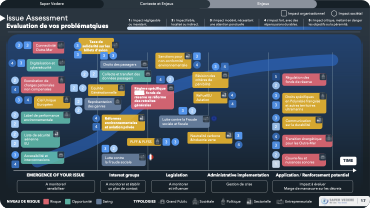
E.g. pollution, obesity, soft mobility. Long battles, where opinion is the central variable. Activation: mass-audience communication, values-based narrative.
E.g. sector subsidies, tax loopholes. The issue is carried by a few players but paid for by everyone. Activation: targeted public affairs.
E.g. regulation of an industry. Visible internal opposition. Activation: sector coalition, competitor benchmark.
E.g. disruptive innovations pushed by a small number against the perceived interest of the market. Activation: narrative of progress, quantified evidence.
This dimension brings a communications logic into an audit historically centred on public affairs. The observation that led to it: many issues are played out as much in audiences as in Parliament. Underestimating communications assets means depriving oneself of an activation lever.
We analyse four strands. Audience quality: composition, engagement, degree of sector influence. Embodiment: who carries the organisation's voice, and with what credibility. Awareness: what stakeholders know about the organisation. Multi-channel presence: channels, cadence, resonance with each segment.
Method: retrieval of the audiences of the various accounts, analysis of profiles, interviews with the client on the offline dimension (events, press relations, institutional presence). To go further, a dedicated training course exists: Audience studies on social media.
This dimension systematically cross-references Connexia, our real-time conversation monitoring SaaS: volume, polarity, active communities, emerging narratives. When tracking an executive's public voice (a typical case being a CAC 40 CEO), this dual reading makes it possible to score their Social Impact Score over time and to compare the company's trajectory with the executive's - two narratives that reinforce or undermine each other depending on the consistency of public statements.
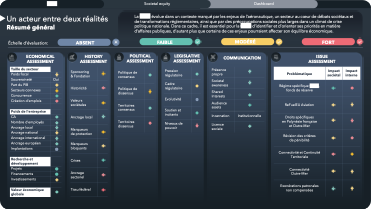
At the end, the audit produces three linked deliverables. A general dashboard that gives the overall assessment of the organisation across the five dimensions. An overview of the key stakeholders and topics of interest that will form the basis of the ecosystem phase. A positioning map that projects where the organisation stands today and where it can go.
These findings are not a PDF to be filed away. They directly feed the next phase: identifying political targets for public affairs activation, identifying the interest shared with decision-makers, choosing the priority activation channels.
The societal audit is scoped precisely. Scope, deliverables, timelines and support arrangements are contracted at kick-off - not a deliverable of variable geometry.
A complete PowerPoint document with a dedicated focus on each of the 6 assets studied: historical, economic, legislative, political, societal issues, societal image. Each asset is presented with its assessment, strengths, weaknesses and tipping signals.
Overall assessment of the organisation across the 6 assets in a single view. Serves as a support for the executive committee: no research, no scrolling, the strategic reading is immediate.
A dedicated workshop with the team, led by the consultants who carried out the audit. No delegation to a junior who would be discovering the file. The analysis is defended in front of your teams, your providers, your executive committee.
Strategic priority for the year, concrete actions, tracking indicators shared with all internal and external teams. Every decision taken during the year is anchored in this roadmap, not in a hurried brief.
The engagement opens with a kick-off meeting: framing priorities, calibrating the methodology, validating the scope and contacts. Throughout the audit, a dedicated point of contact is available by phone and email - not a ticketing bot.
Findings are presented in a dedicated oral workshop with the consultants who carried out the audit. No delegation to a junior profile who would be discovering the file. The analysis is defended in front of your teams, your providers, your executive committee.
Each year, we update the societal audit to check that assets are moving in the right direction. This update drives the adjustment of the strategy, reinforces what works and corrects what does not. The audit becomes the shared reference of the executive management.
Added value is measured in the achievement of concrete objectives. As soon as a result is precisely defined, the strategy, the indicators and the means of achieving it become obvious. It is this focus on results that pushes us to keep improving and to refuse any inertia.
Our method works like a sterile laboratory: a clear, objective framework. Proven and mastered, it lets us state precisely what we deliver, by when, and with what concrete results. This rigour, combined with our ability to replicate it efficiently, ensures continuity over time.
We move beyond sector silos to offer a cross-cutting, strategic reading of the issues. We look at society as a whole, so that decisions and objectives can be taken from the necessary height - where specialist firms deliver narrow angles, we deliver a defensible overall framework.
We play every instrument available in the service of your result. The key is not knowing which tool to use, but how and why to deploy it. The clearer the priority and the expected results, the more effective the instruments deployed.
At the start of an advisory engagement, during tenders, when a new decision-maker arrives, or at the opening of an ecosystem workshop. What these moments have in common: a structuring decision is about to be taken, and prior understanding changes its quality.
The societal audit covers the organisation as a whole across six assets (historical, economic, legislative, political, societal issues, societal image). The audience study zooms in on the composition and engagement of digital audiences, and sits within the societal image asset. One opens up, the other goes deeper.
Four interlinked deliverables: a PowerPoint report with a focus on each asset, a summary dashboard across the 6 assets, an oral presentation of findings in a dedicated workshop, and a roadmap with shared tracking indicators. Plus a dedicated contact point by phone and email throughout the engagement.
Because our services follow on from one another: an audit leads to an audience study, which leads to an ecosystem mapping, which leads to a strategy, which leads to activation, which leads to monitoring. Selling an audit in isolation, without what follows, would amount to delivering a diagnosis without treatment.
Follaw feeds the regulatory dimension: analysis of parliamentary questions, detection of co-amendments, identification of active legislative coalitions, and tracking of the footprint of interest representatives. It is the source that sets us apart from conventional audits based on the manual reading of reports.
Let's discuss your strategic challenge. No-commitment first conversation.