



In an ever-changing professional world, LinkedIn presents itself as an essential platform for company leaders. Yet our recent study of SBF120 CEOs’ engagement highlights a surprising finding: despite their position of influence, these leaders are relatively inactive on the social network. Let us see why!
CEOs with low activity but interesting engagement
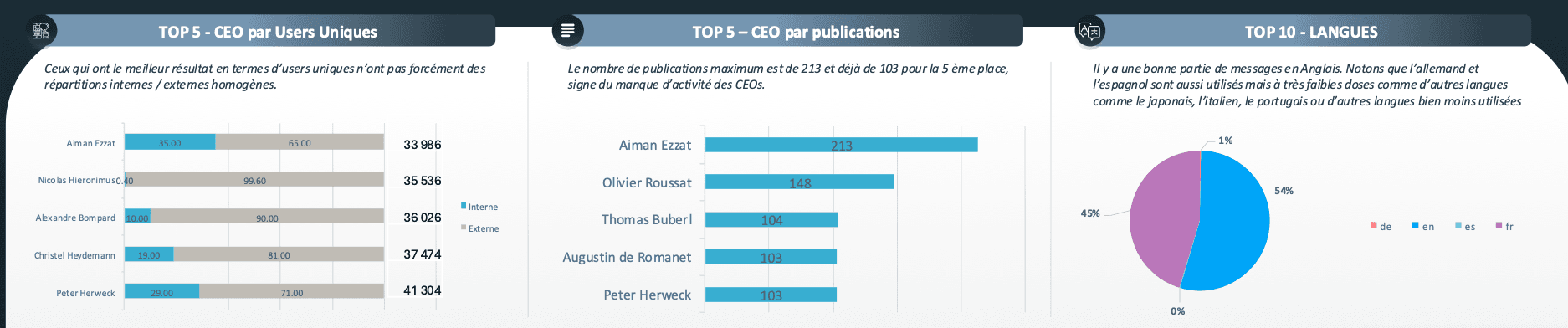
The study reveals that SBF 120 CEOs are not very active on LinkedIn, despite significant potential. On average, each executive publishes only 41 posts, and only 74 CEOs are genuinely present on the platform. This low activity translates into limited engagement, with most interactions coming from outside (78% of likes). Our takeaways:
- Mostly external engagement: 78% of likes come from external users, with low internal mobilisation (22%).
- Few genuinely active executives: Only a few CEOs, such as Aiman Ezzat (213 posts), stand out with a strong presence, while the majority stay in the background.
- Languages used: English dominates at 54%, followed by French (45%).
Typology of CEOs
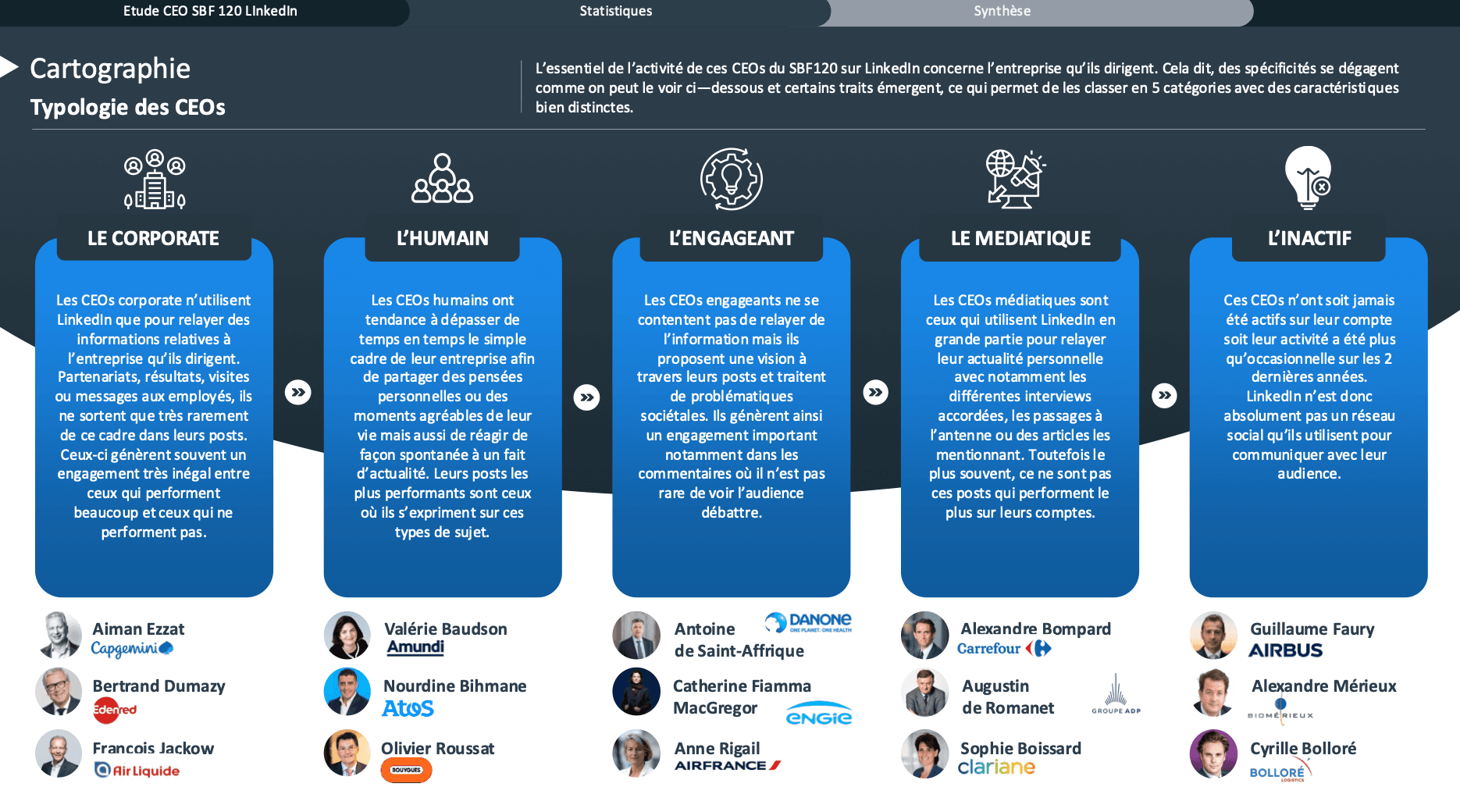
Most of these SBF 120 CEOs' activity on LinkedIn concerns the company they lead. That said, specific features stand out and certain traits emerge, making it possible to classify them into 5 categories with clearly distinct characteristics:
1.The corporate: Corporate CEOs use LinkedIn only to relay information about the company they lead. Partnerships, results, visits or messages to employees: they very rarely step outside this framework in their posts. These often generate very uneven engagement between those that perform strongly and those that do not.
2.The human: Human CEOs tend to go beyond the narrow scope of their company from time to time, to share personal thoughts or pleasant moments of their lives and also to react spontaneously to a news event. Their best-performing posts are those in which they express themselves on these types of subject.
3.The engaging: Engaging CEOs do not simply relay information; they offer a vision through their posts and address societal issues. They thus generate significant engagement, notably in the comments, where it is not uncommon to see the audience debate.
4.The media-facing: Media-facing CEOs are those who use LinkedIn largely to relay their personal news, notably the various interviews given, broadcast appearances or articles mentioning them. Most often, however, these are not the posts that perform best on their accounts.
5.The inactive: These CEOs have either never been active on their account or have been no more than occasionally active over the last 2 years. LinkedIn is therefore absolutely not a social network they use to communicate with their audience.
Extremely disparate audiences
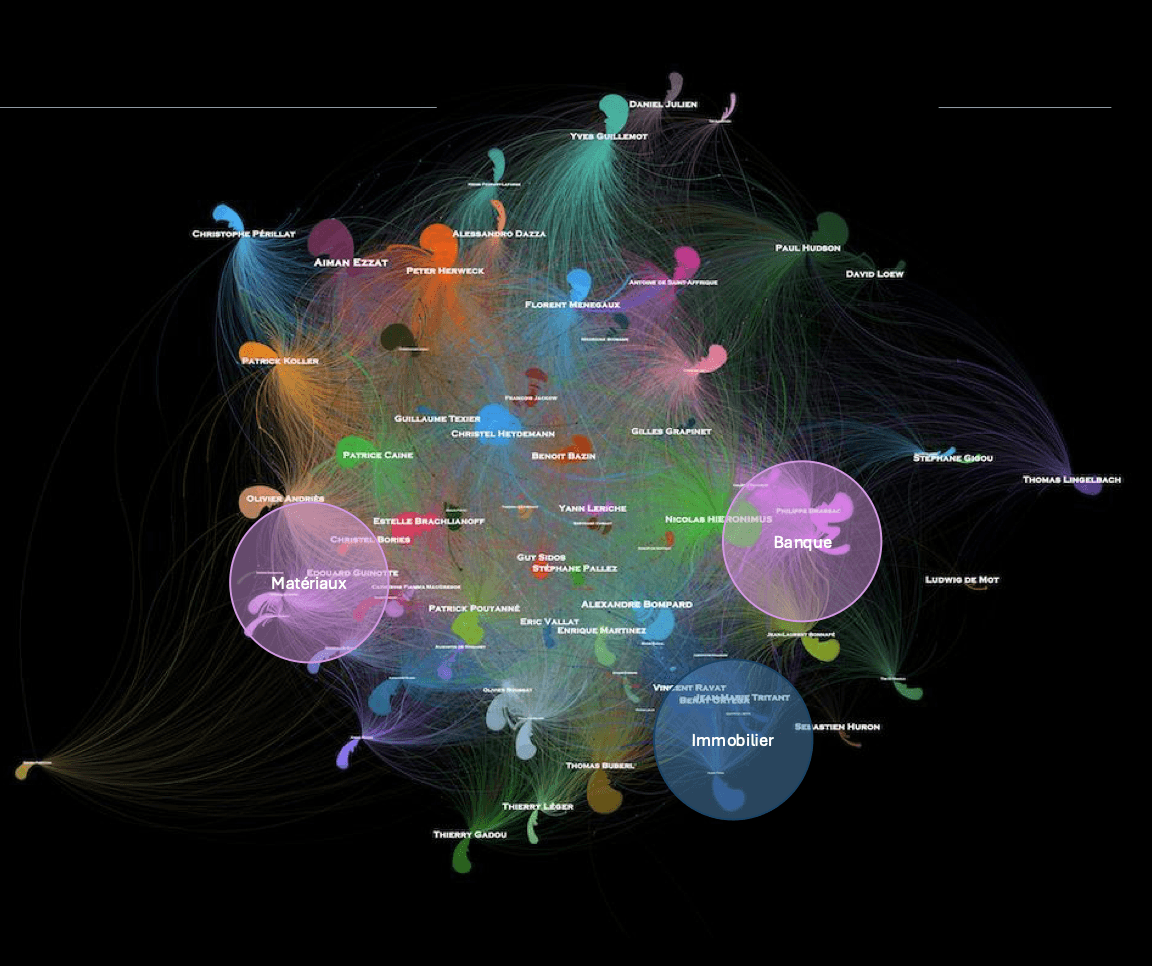
In the CEO mapping below, we observe that:
- Each CEO has an audience of their own.
- Only the financial, property and construction sectors seem to have a logic that looks a little like a community.
- Recurring audiences between CEOs are small
Remember, you are on LinkedIn
LinkedIn is a professional environment where opportunities are plentiful but certain limitations remain. Here are the main points:
- LinkedIn has a good business environment, with a strong presence across various professional fields. The platform has potential, symbolised by “gold in your hands”.
- LinkedIn's algorithm combines those of networks such as X (formerly Twitter) and of content platforms such as Facebook or TikTok, but struggles to connect people. Its engagement rates, however, far exceed those of X.
- Paying for more visibility is not effective: later posts are penalised, and ads perform worse than on other platforms.
- Microsoft, LinkedIn's owner, knows the “growth hacking” techniques but not the needs of companies, and the data collected is of little interest.
- To succeed on LinkedIn, you have to exploit the platform at its own expense, using techniques such as scraping, growth hacking and private messages.
Two key insights
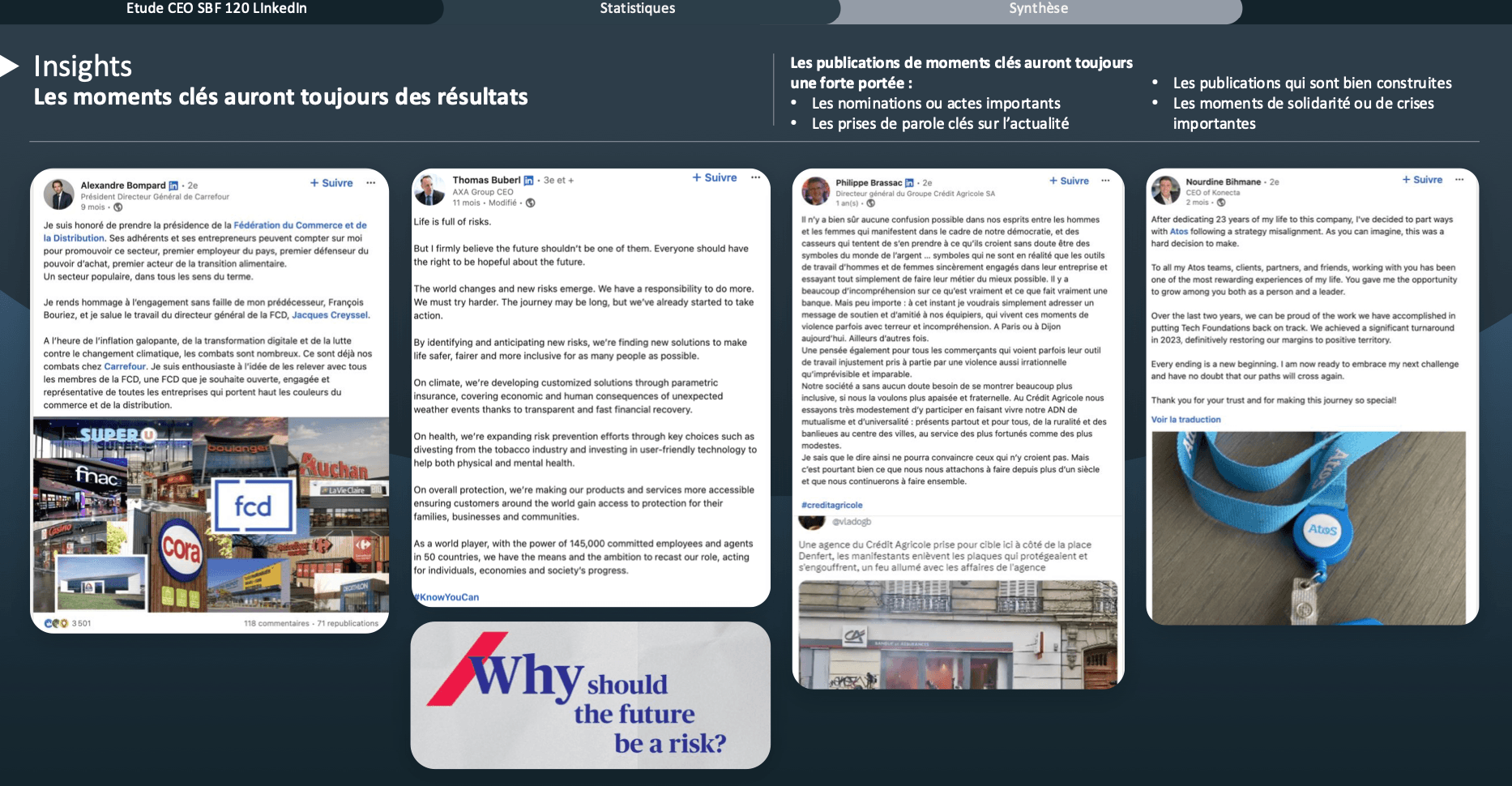
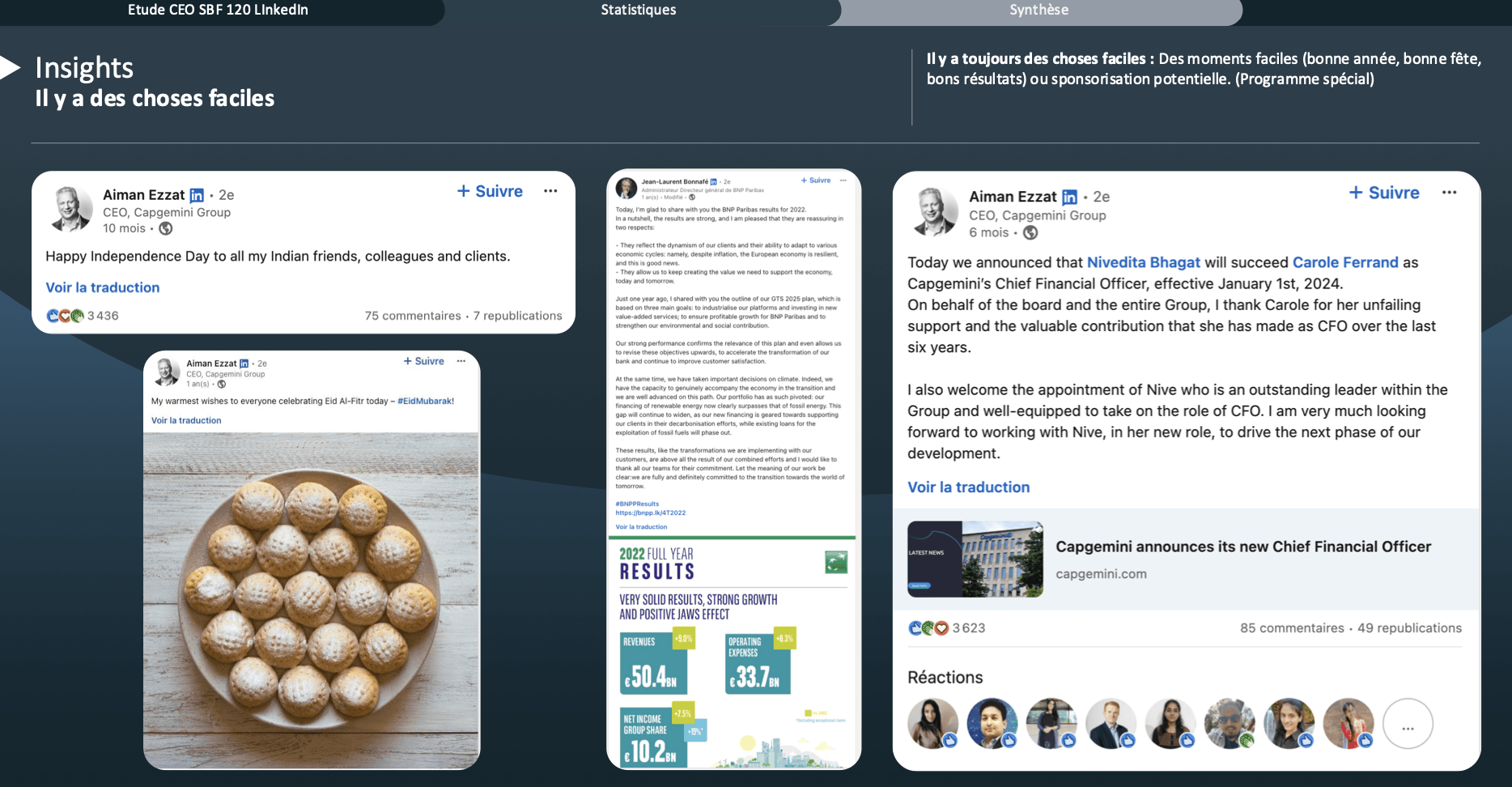
Saper Vedere's recommendations
Think about your formats: Use formats favoured by the algorithm, such as photographs. Shares work poorly and the length of posts matters.
Internal posts and “this happened” posts do not work: The worst posts are those that comment on events, partly because they share other posts, but also because most people have no interest in this type of content. Favour commenting.
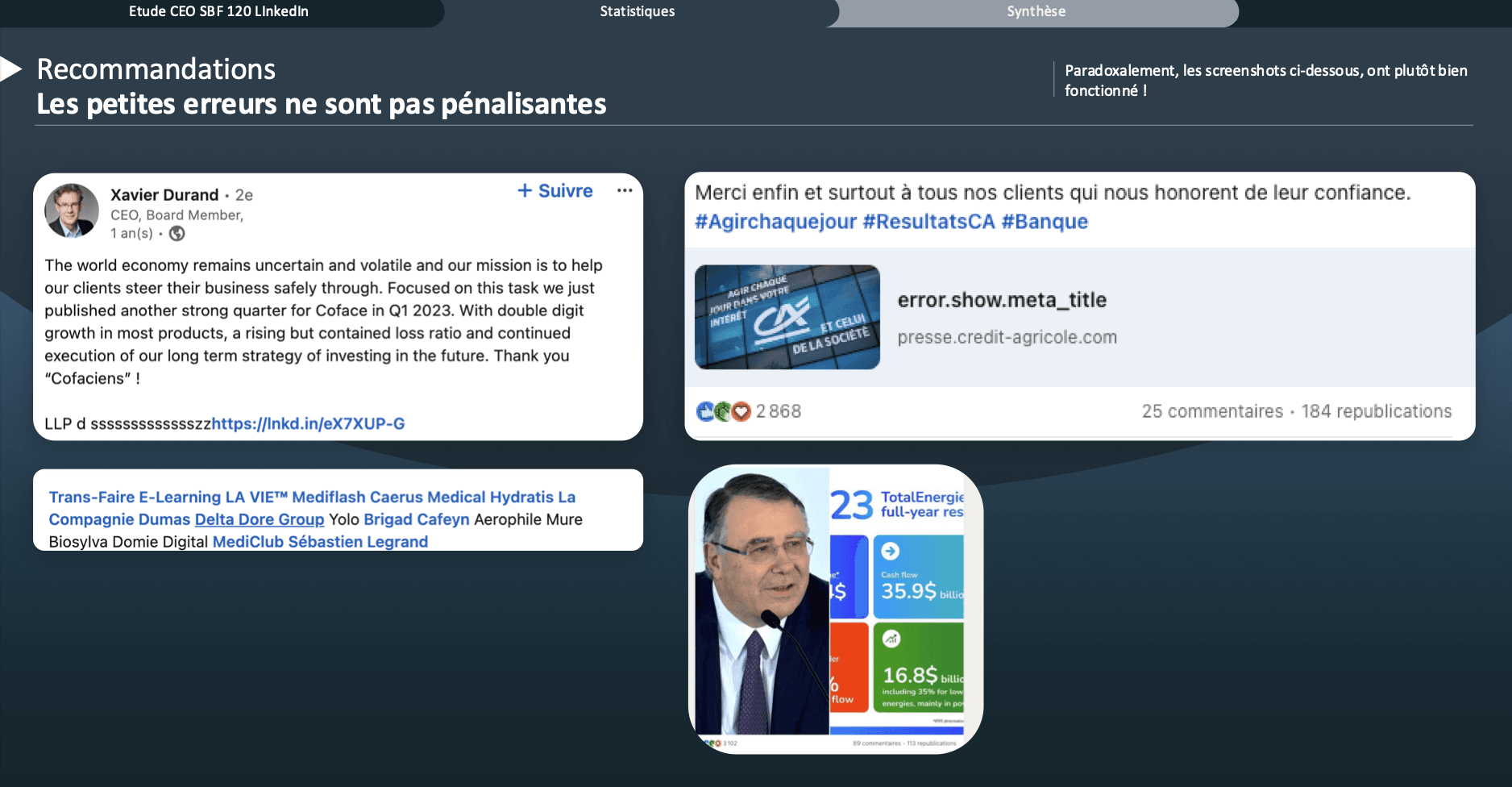
Small mistakes are not penalised: Paradoxically, the screenshots below performed rather well!
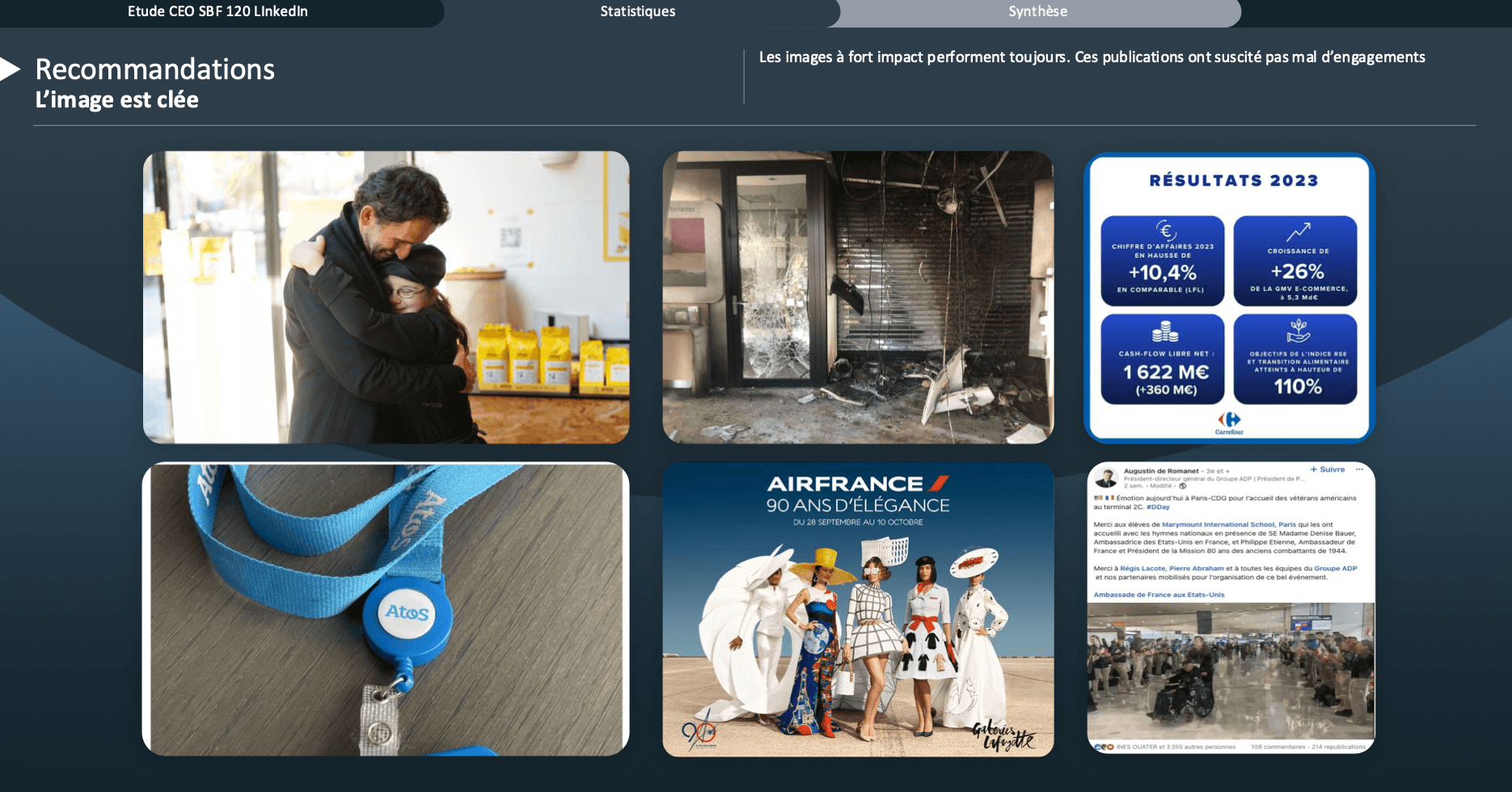
The image is key: High-impact images always perform. These posts generated quite a lot of engagement.
Language management is problematic: Because of LinkedIn's “look-alike audience” algorithm, managing languages is very complicated, whether by using translations within the post or by writing in unusual languages.
Hashtags are useless: Hashtags are useless. Use them in the following cases: to join a campaign (a hashtag) or to categorise your own content (study / curation).
In conclusion
It is crucial to rethink your approach to LinkedIn to avoid certain common strategic mistakes. First, keep in mind that LinkedIn belongs to Microsoft, which influences its priorities. Contrary to the usual recommendations, sharing indiscriminately is a mistake : do it only in a targeted and strategic way. In addition, favour using a single language to ensure clear and consistent communication, and avoid posting in Polish, which can harm your impact.
Next, “well-done mode” is ineffective, except when it brings all the key players together around a success (colleagues, partners, journalists, etc.). Avoid stereotyped posts such as “Martine at such-and-such event” or obvious visuals of the “cheese-smile” kind; they no longer captivate the audience. By contrast, a well-chosen image is often worth more than a thousand words and should be at the heart of your strategy.
Do not set yourself quantitative targets, but realistic management objectives to be achieved through LinkedIn. Hashtags, for their part, are useless: this is not Instagram. Finally, remember that it is futile to fight the algorithm. Adapt to its updates and adopt the behaviours it favours. Post regularly, because the more you post, the more LinkedIn rewards you in visibility and opportunities.