




SBF120 CEOs and their presence on Twitter
Twitter is one of the most influential social networks, and it is interesting to see that more and more company leaders are investing in it. A study of SBF 120 company leaders highlights interesting trends in their presence on the platform. In this article, we explore the results of this analysis, looking at CEO activity on Twitter, audience engagement and the implications for the companies themselves.
SBF 120 CEOs on Twitter: a playground rarely visited
The study reveals that, although the vast majority of SBF 120 companies (96.6%) are present on Twitter, only 38.3% of CEOs have an account. Among those who do, few regularly publish original content. Yet for those who commit fully, the results are significant: their posts generate strong engagement, proving that executives' authentic content resonates with their followers.
A key aspect of the study concerns the overlap of audiences between CEOs' accounts and those of their companies. For example, companies well established on Twitter, such as Total or Orange, have a large audience, and their CEO benefits from a strong affinity with the company's followers. By contrast, figures such as Ilham Kadri (Solvay) or Augustin de Romanet (ADP) manage to attract more followers to their personal account than to their company's.
The study also highlights sector trends. Some industries seem better placed to attract followers on Twitter. The energy sector, for example, records a high overlap rate between company followers and CEO followers, reaching as much as 57% for companies such as EDF or Engie. At the other end, large-scale retail, with companies such as Carrefour or Fnac, shows a low audience overlap, with only 21% of followers following both the company and its chief executive.
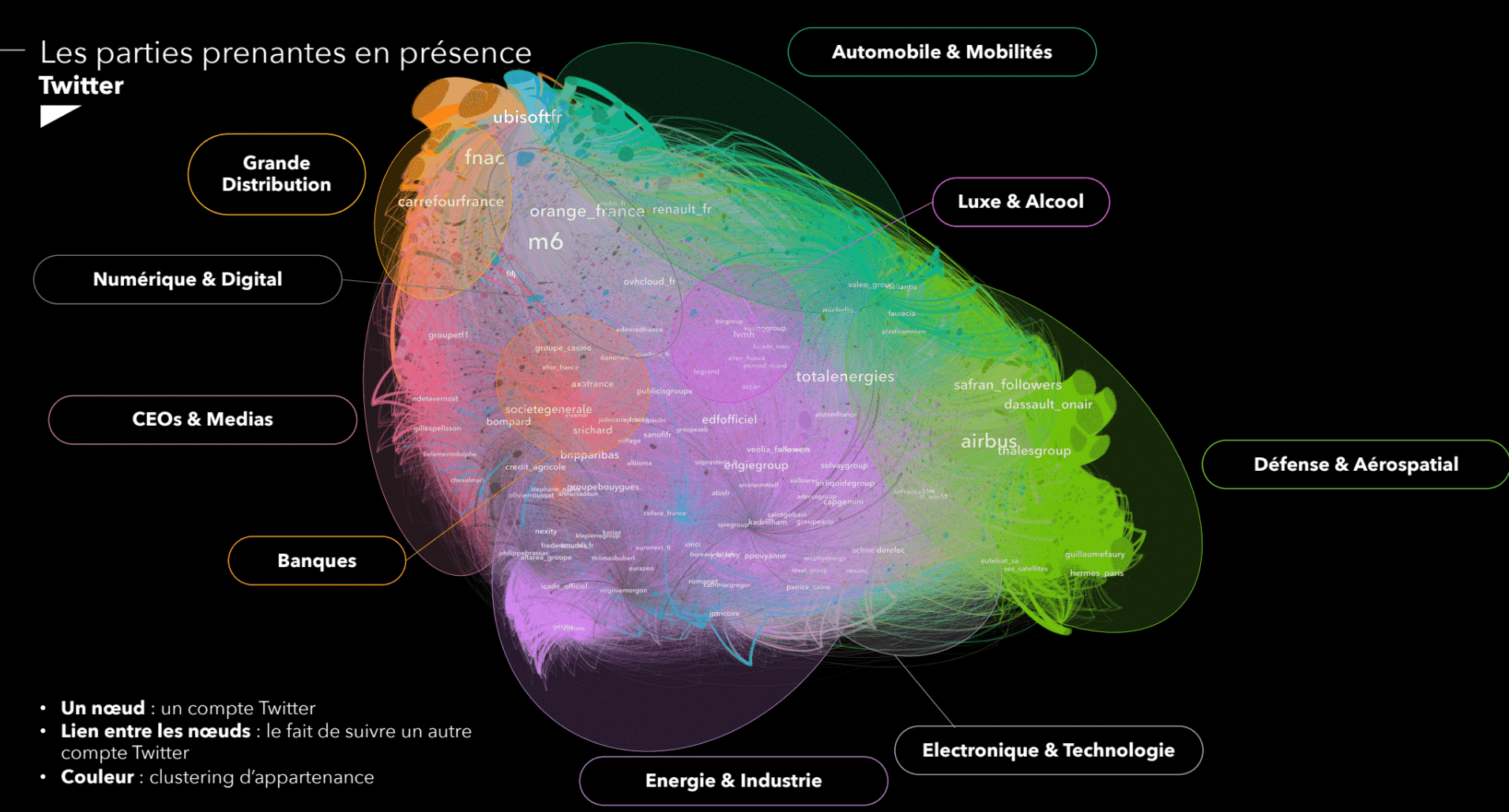
Types of CEO on Twitter: from corporate to “human”
The study identifies several types of CEO profile active on Twitter:
- The corporate CEO: These executives mainly use Twitter to share formal information about their company. Their audience is strongly correlated with the company's. Notable examples are Guillaume Faury (Airbus) and Aiman Ezzat (Capgemini).
- The media CEO: This type of CEO, like Alexandre Bompard (Carrefour), uses their platform to share their media appearances and more varied content. Their audience is large and often more diverse, attracting followers from different backgrounds.
- The human CEO: A little more personal, this type of CEO sometimes shares aspects of their private life, their passions or their opinions. Bernard Charlès (Dassault Systèmes) and Thomas Buberl (AXA) are typical examples, with a more diverse audience that goes beyond their company.
- The itinerant CEO: These executives, who have changed company several times, have an audience built up in their previous careers. Their challenge is to win over a new audience for their current company, as Rodolphe Belmer (Eutelsat) has done.
The best strategies for a CEO on Twitter
For executives who want to build their presence on Twitter, we recommend a few key strategies:
- Authenticity and original content: Publishing personal, engaging content.
- Synergy between the CEO and the company: The CEO can use their personal account to redirect attention to the company's account.
- Media visibility: Media-facing CEOs who appear in traditional or digital media attract a wide range of followers.
Conclusion
SBF 120 CEOs show a varied presence on Twitter, with some drawing on their media status to strengthen their influence and their company. However, few executives appear to exploit the platform's full potential. Those who do reap significant benefits, particularly when they integrate their company into a coherent communication strategy.